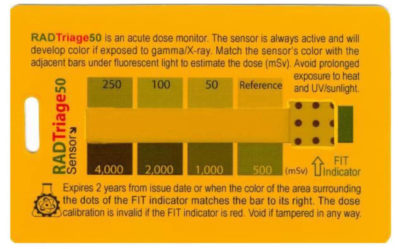
The RADTriage 50 Radiation Detector is a U.S. Military-grade personal dosimeter that instantly detects radiation exposure in the event of a dirty bomb, nuclear reactor accident such as Fukushima and Chernobyl and other sources of radiation. This always-on wallet card/badge radiation detector does not require batteries or calibration. The sensor strip instantly turns darker when it detects harmful levels of radiation.
- Instant detection of radiation from sources such as nuclear reactors (Fukushima), nuclear bombs and dirty bombs
- No batteries or calibration needed
- Impervious to an EMP Bomb (electromagnetic pulse)
- Field tested and approved by Dept of Homeland Security
- Service life of at least 2 years. (see shelf life below)
- Extend shelf life by storing in freezer for up to 10 years.
- U.S. Military grade
- Made in the U.S.A
- Fits wallet or badge holder
- Will instantly detect radiation while stored in wallet, badge holder, pocket, etc.
- Also available in our complete line of Radiation Protection Emergency Kits
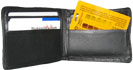
Fits in wallet, pocket or badge holder while continuing to monitor for radiation

The darker the sensor strip
the higher the radiation dose.
DHS Test Report Findings
From the Department of Homeland Security (DHS) Final Test Report on the RADTriage (SIRAD):
– “If routinely carried by emergency responders, it could provide early indication of a significant radiation component after a terrorist event and measure individual responder dose for planning lifesaving operations. It could also reassure first responders of a lack of radiation, which could avoid response delays due to fear of radiation. Pre-distributed SIRADs [RADTriage] could provide early data on the ground to assess the scope of a radiation event. This data could assist identifying those in the public that potentially received a significant radiation dose.”
– RADTriage was found to demonstrate “acceptable performance for homeland security mission needs. If routinely carried by emergency responders, it could provide early indication of a significant radiation component after a terrorist event”.
– “The SIRAD [RADTriage] demonstrated generally acceptable performance for homeland security mission needs. Incidence of loss or damage to the device during field deployment was low, false positive rates were less than one percent, and field conditions and physical stresses did not seem to compromise performance.”
Military-grade RADTriage 50 Radiation Detector impervious to an EMP bomb
RADTriage will continue to instantly detect radiation after an Electromagnetic Pulse (EMP) bomb detonation because it has no electronics.
RADTriage information
Objective of the RADTriage™
Introduction
Types of Radiation
How to Read Dose with RADTriage™
Effects of Heat and UV Light
False Positive and Tamper Indicators
Shelf Life
UV/Tamper Detector
Reporting Exposure
Department of Homeland Security Evaluation Against Test Criteria
Warranty
Objective of the RADTriage back to top
The RADTriage, a stockpileable personal radiation detector, provides wearers, medical personnel and law enforcement personnel timely personal radiation exposure information in an event of a terrorist radiological incident or industrial accident. RADTriage, with the amber laminated filter, provides significantly longer life in direct sunlight. The RADTriage, part of the SIRAD (Self-Indicating Radiation Alert Dosimeter) family of SMART dosimeters, is uniquely designed to prevent erroneous readings. It has a sensor (a rectangular strip between the color bars) with 0 (reference), 50, 100 & 250 mSv bars on its top and 500, 1000, 2000 and 4000 mSv bars on its bottom for triaging information in emergencies. If, during or after the incident, the color of sensor has not changed, the wearer has not received radiation exposure large enough to cause acute medical effects and therefore has peace of mind. If the sensor changes color, radiation exposure is indicated. In this case, further exposure should be avoided. The RADTriage does not reset itself after exposure to radiation and should at that time be replaced. If the Sensor has developed a darker color, e.g., above 250 mSv, the user should seek a medical evaluation. A person exposed to a dose higher than 500 mSv should immediately contact the emergency room of the nearest hospital.
Introduction back to top
The RADTriage (USP# 7,227,158 and others) is always active and ready to use. It is a smart dosimeter and has the capability of monitoring shelf life, false positives/negatives and tampering. When exposed to radiation, e.g., from a “dirty bomb”, the sensor of the RADTriage changes color instantly. The color changes are permanent, cumulative and proportional to dose, thereby providing the wearer and medical personnel instantaneous, easy to read information on radiation exposure of the wearer to assess the health risks and guide medical treatment. The RADTriage does not reset itself after exposure to radiation and should at that time be replaced.
Types of Radiation back to top
The RADTriage sensor responds to gamma/X-ray (energy higher than 30 KeV) and high energy (e.g., above 1 MeV) electrons/beta particles. Color development of the Sensor is essentially independent of dose rate. However, protective films attenuate low energy (below 200 KeV) X-ray. RADTriage will not be affected by normal exposures to diagnostic X-rays (e.g., chest or dental) or security/airport X-ray/CAT scan machines, except that multiple exposures (more than five) to such will result in sufficient enough exposure to produce a detectable color change in the sensor.
How to Read Dose with RADTriage back to top
Estimate the exposure dose by comparing the color of the sensor with the Sensor Reference Bars. Find a bar which closely matches the color of the sensor and read the dose in mSv printed adjacent to those bars. If the Sensor develops a color in-between any two adjacent bars, this indicates an in-between dose. For a nearly tissue equivalent dosimeter, such as RADTriage, 1 rad = 1 rem = 10 mSv. It can be viewed in any light. However, we recommend reading the dose under fluorescent lights for better accuracy. Color matching under other lights may not be as accurate. Dose can be estimated with an uncertainty of about 20% with a color-matching reference chart. Where additional accuracy is needed, a spectrophotometer or an optical densitometer can be used to determine the dose to within 10%. The RADTriage does not reset itself after exposure to radiation and should at that time be replaced.
Effects of Heat and UV Light back to top
The sensor of the RADTriage will develop colors faster if exposed to UV/sunlight for a prolonged period. Keep the RADTriage at or below normal room temperature. Repeated, e.g., hundreds, of readings where the sensor gets exposed for less than a minute per reading (even under direct sunlight) will cause little or no color development in the sensor.
False Positive and Tamper Indicators back to top
If used as per instructions, it is unlikely that the RADTriage will provide false positives or false negatives. Your RADTriage is a SMART personal dosimeter, equipped with a simple-to-use revolutionary indicator for monitoring the deliberate or inadvertent exposure to high temperatures or ultraviolet light. We call it the FITIndicator (False-positive, Inactivation and Tamper) and it is located on the right hand end of the sensor. The FIT Indicator simultaneously monitors false positives & negatives, overexposure to heat & UV/ sunlight, shelf-life, inactivation and/or altered sensitivity.
Inactivation & False Negative Indicator: If the dots of the FIT Indicator is dark blue, the sensor is active, it is monitoring radiation and the calibration is valid. However, if it has changed to red, your RADTriage has been heated near or above 175oF/80oC which has made the sensor inactive to radiation or of altered sensitivity to radiation. DO NOT USE the dosimeter if the dots of the FIT Indicator are red. Turn the dosimeter in to the issuing organization with a description of the circumstances. The heat treatment can be used by medical authorities to fix the sensor for permanently documenting the radiation exposure as a part of a medical record. Medical personnel requiring this capability should contact the distributor, Nukepills.com.
False Positive Indicator: The shelf life (expiration date) of the dosimeter is based on storage of the RADTriage at room temperature (77oF/25oC) or below and continuous protection from ultraviolet/sunlight exposures. Shelf life will be reduced if it is stored at higher temperatures and/or exposed to UV/sunlight for a prolonged period (e.g., more than a few hours of direct sunlight). The area surrounding the dots should be lighter in color when issued/purchased. If it has developed a color matching or darker than the Color Reference Bar on its right, the shelf-life of the RADTriage has expired; it was overexposed to UV light, and/or exposed to higher temperatures for a prolonged period. The sensitivity of the FIT Indicator to X-rays is hundreds of times lower than that of the sensor.
Shelf-Life back to top
The sensor of the RADTriage will develop color equivalent to about 10 mSv in about two years if stored at 77oF/25oC. The shelf-life/warranty of the RADTriage expires two years from the sell date and definitely when the color of the area surrounding the dots of the FIT Indicator matches or is darker than the Color Reference Bar on the right hand side.
The shelf-life of the RADTriage50 can be extended up to 10 years by storing in the freezer. Once removed it will have a usable life of at least two years as described herein.
UV/Tamper Detector back to top
A small portion of the sensor is covered with the FIT Indicator. The substrate of the FIT Indicator is 100% opaque to visible and UV light but transparent to X-rays and gamma-rays. If the color development of the sensor is due to exposure to high energy ionizing radiation, the whole sensor will be uniformly colored. If the color development of the sensor is due to exposure to UV light, the color of the sensor under the FIT Indicator will be lighter. If you suspect the color development of the sensor is due to exposure to high energy ionizing radiation, return the RADTriage to Nukepills.com. For a fee, we will remove the sensor for determination of genuine exposure or false positive.
Reporting Exposure back to top
If the sensor of the RADTriage develops darker color and the color development is not due to prolonged exposure to high temperatures, UV/sunlight, and/or expiration of shelf life, estimate the dose and immediately report it to the department/agency/organization issuing the dosimeter. Seek advice and medical help immediately from your agency/company medical office, your personal health care provider or county public health office, especially if the dose is higher than 250 mSv. For a dose higher than 500 mSv, report to the nearest Emergency Room.
Department of Homeland Security Evaluation Against Test Criteria back to top
For full DHS report click here
• Is the SIRAD [RADTriage] format usable by emergency responders without significant damage, loss, or interference with operations?
Yes. In the field deployment, 8 percent were lost, 10 percent were found to have slight damage (which did not affect their performance), and less than 1 percent were damaged severely enough to compromise performance. Feedback from participants was positive.
• In routine field deployment, does the SIRAD [RADTriage] have a false positive probability of less than 1
percent?
Yes. The positive readings observed in the field deployment were for 4 dosimeters having obvious, severe damage to the protective cover, which identified them as suspect. These did not cause concern among the users: they were light blue and were interpreted by the POC as less than 50 mSv. They represent less than 1 percent of those deployed.
• Are the SIRAD [RADTriage] radiation response and calibration acceptable in the context of existing standards for other types of emergency dosimeters?
Yes. The SIRAD [RADTriage] was tested against ANSI N13.11, though such a standard would likely be considered too high for a device that is not intended to be used for a legal dose of record. The SIRAD [RADTriage] performed reasonably well, passing one of the three categories tested, even when doses beyond its upper scale range were included. The laboratory tests revealed a difference in response to photons of different energies (73 and 662 keV), which is common in many dosimeters including TLDs, where it maybe corrected with filters or calibration adjustments). Since the SIRAD [RADTriage] was shown to over-respond to higher energy photons, it would tend to err on the side of caution in this case.
• Can the color scale on the SIRAD [RADTriage] card be accurately interpreted visually?
Not in all cases, but this should not be significant for the intended tactical applications. Color interpretation is subjective and corresponding numerical dose estimates vary between individuals, so the SIRAD [RADTriage] should not be used for routine occupational dosimetry of record. However, doses significantly (factor of 3) above a reference decision level of 250 mSv apparently can be easily identified for tactical decisions, despite the differences in assigning a corresponding numerical value. Future studies will investigate this topic in more depth.
• Are the manufacturer’s specifications accurate?
Yes, in most cases. The specifications for functional temperature and light conditions, and photon, and beta response are accurate. However, the SIRAD [RADTriage] did not demonstrate neutron sensitivity. Since neutrons are difficult to measure, this is common among other types of photon dosimeters and it is not crucial for the intended application since neutron sources are expected to have a significant gamma component.
• Does the card function under potential end-user environmental stresses?
Yes. Dosimeters returned from the field, left in a hot automobile, and put through the laundry continue to function.
• Is the SIRAD [RADTriage] card appropriate for use by first responders for preparedness for potential radiological terrorist events?
Yes. It provides a color change that gives a field readable indication of a significant radiation exposure that could be valuable for tactical operations. Its low-cost and convenient format do not interfere with operations and would be useful for pre-distribution to emergency responders who would not otherwise use dosimetry but could be involved in the early response to a terrorist event.
Warranty back to top
Reasonable efforts have been made to make this product free from defects. It is expected to perform as specified if used as recommended and instructions are followed. In the event that the product does not perform as specified, JP Laboratories, the manufacturer, will replace the product. JP Laboratories specifically disclaims all other warranties and liabilities expressed or implied. All warranties are null and void if any of the following occur: (1) the dots of the FIT Indicator are purple or red and/or the area surrounding the dots is matching or darker than that of its Color Reference Bar and (2) the RADTriage is tampered with in any way.
The shelf-life/warranty expires two years after the sell date.
Note: A normal residential laundry cycle of washing and drying (below 175°F/80°C) has a negligible effect on the RADTriage. However, repeated laundry cycles or exposure to temperatures higher than 175°F/80°C will damage the sensor and hence must be avoided. Replace the RADTriage if it is subjected to boiling water or more than one laundry cycle.